Showing posts with label Fonkert. Show all posts

Tuesday, February 16, 2016

Haven't Lost My Mind... Found it... The Photo, I Mean

A few weeks ago (January 28), I wrote about how I discovered that Kate Zorgdrager's given name was Tryntje. The entire time I was working on that blog post, I thought I was losing my mind. In my minds eye I could see a colorful certificate, complete with bluebirds and colorful flowers, documenting the marriage of Kate Zorgdrager and John Fonkert. I knew I had a photo of it, but after searching high and low, through photo albums and boxes, I could not find it.

Well, I just found it last night!


This scan is from a 3.5" x 5" print, which tells you something about how many years ago I took the photo -- sometime in the 1980s before I even knew genealogy existed. It also means I should have a color negative or transparency (slide) of it somewhere.

Why just a negative or transparency?  You see, I am quite certain I do not have the certificate itself.  As I recall, my Dad had borrowed some old family photos -- and, I think, also the marriage certificate -- from my Dutch aunt. I laid them out on the floor of the garage and photographed them. My memory says that they all then went back to my aunt (died 1902), and despite queries to her children, never saw the again.

So much family memorabilia is lost between generations. Thankfully, I took photos of this certificate.

Thursday, January 28, 2016

What's in a Name?

What's in a name? Heck, what was the name?

This is the story of my Dutch grandmother's name. I really never knew her -- our lives overlapped by only about 18 months. I guess I must have heard my Dad and my uncles and aunts talk about her. I'm not certain, but I think they called her Kate --- when they didn't call her Ma.

She was known as Kate when shed died in 1951. Her obituary in the Sioux County Capital named her Kate. She is Kate on her gravestone. My Dad had entered her name as Kate Zorgdrager in some primitive home-made family group sheets he created on his pre-electric, heavy as an anvil, manual typewriter. In the early 1990s, when I started researching her ancestry, I did not have access to the 1930 or 1940 censuses, but both the 1910 and 1920 censuses recorded her as Kate. She was Kate in the registration of her 1903 marriage to Jan (aka John) Fonkert. She has eluded my searches in the 1900 census; she was not living with her parents in Holland Township.

Jan Fonkert and Kate Zorgdrager, 1903
From the marriage record, I knew that her parents were Sipke Zorgdrager and Trijntje de Vries. Censuses told me that Kate was born about 1883 or 1884 in Iowa.  I wish I could accurately remember the chain of events behind the story I am about to tell. Suffice it to say, it took me several years to fully understand why this beautiful Dutch girl was known as Kate.

At some point (back in the microfilm days, as I recall), I found the Zorgdrager family in the 1885 Iowa census of Sioux County. Sipke Zorgdrager had a 1-year old child named Tryntje. I had been expecting Kate. Sipke's wife was also named Trynte, I was  mostly convinced that Kate and  1-year old Trijntje were one and the same. However, I didn't see how Tryntje could have become Kate.

Even my Dad's birth certificate -- a "delayed" certificate issued in  1950 -- named his mother "Kate." Birth registrations for his sister, Nellie, and brother, Peter, also called their mother Kate.

Now comes the part I wish I could remember better. I had learned that that the Zorgdragers had come from Terschelling, a North Sea island just of the coast of Friesland, a northern province of The Netherlands. Using the WieWasWie index (http://www.wiewaswie.nl) of Dutch civil registration records, I can sort of reconstruct how I figured this all out.  First, I found several young girls on Terschelling named Catharina. Even more interesting, I found the K-version of the name fairly common on the mainland: Katharina, Katrijn, Katrijne. On Terschelling, I found many young girls named Trijntje.

If I had only had at hand a copy of Christine Rose's Nicknames Past and Present I could have just looked it up. In an appendix of Dutch and Frisian names, she states that Katrijn is the Dutch equivalent of Catherine and that the English names Kate or Kathleen derive from Katryntje.

It dawned on me that "Tryjn" was a shortened version of Kathrijn or Katharina. The, their was the matter of the "je" at the end of the name. At some point, I learned that the suffix "je" is a diminutive applied to female names, literally meaning small, but in the case of names indicating affection.

When I was struggling with these names 20 years ago, the Internet was in its infancy. Now, you can find numerous articles, and even a few videos about the "je" suffix. The first one I clicked on hit the spot. Try https://www.youtube.com/watch?v=jTo31XqnhEk/.

So, was Tryntje a casual version of something like Trynt? Not quite. It turns out that Tryntje was a shortened version of  Kathryntje. Yep, Tryntje was derived from Katherina, and of course, in America Tryntje was anglicized to Kate.

 Only when I found my great-grandfather's will did I see an official record calling her Tryntje. Sipke Zorgdrager willed a portion of his estate to Tryntje Fonkert, and when she gave a receipt for $20 from the estate, she signed her name "Tryntje Fonkert." Kate's given name was Tryntje.


So, what's in a name? Would you care to guess about Zorgdrager? I will dig deeper into the Zorgdragers next week.

A final note on spelling -- The "y" in Tryntje is not really the letter "y." Instead, it is the Dutch letter ÿ, representing a "long i." Today, it is commonly typed as "ij." So, you might see either either Tryntje or Trijntje instead of Trÿntje. You can type "ÿ" by holding down the alt-key while typing 0255.


Thursday, January 21, 2016

So, Maybe Dad Did Get to Okinawa

When I took up the Fonkert history five or six weeks ago, I thought it would be just a two or three week tour -- something easy to blog about over the holidays. Well, I've got at least one more story to tell before I go on to some other strange family like the Tidballs or Zorgdragers. (Yes, those are real family names).

Sometimes family history researchers know the least about the ancestors they think they know the best. We usually know who our parents are and where they came from, so we don't spend much of our research time on them. I know my Dad was in the army during World War II, but he never seemed to want to talk about it. I also know that most 20th-century military personnel records were lost in a 1973 fire at the National Personnel Records Center in St. Louis, so I figured my chances of finding anything were slim, anyway.

I do have a vague memory of Dad saying he had been in Okinawa, and I have some old black and white snapshots that look like they could have come from that part of the world. Of course, I can't find them now.  I could also swear I remember seeing a record somewhere (quite recently, somewhere in my files) that states he served on a hospital ship as a chaplain's assistant, but now can't lay my hands on it, either.  So, let's start with what I have.

First I have a copy of his honorable discharge filed at the Sioux County, Iowa, courthouse.  It gives his serial number and states he was discharged as a technical sergeant from "Ship Complement 9222nd Transportation Unit in the Army Transportation Corps." His occupational specialty number was NCO 502 -- an administrative job title. He served outside the U.S. on the SS Marine Flasher -- he was on a ship! He had received the Asiatic Pacific Campaign Medal -- perhaps he really was on Okinawa.

He was discharged at Ft. Dix, New Jersey, but I think he might have come ashore at Seattle, where he met my mother (see January 14 post). His World War II bonus application states that he departed on foreign service 7 August 1945 -- the day after Hiroshima. He returned from foreign service 26 March 1946.

So, what was the SS Marine Flasher? It was a Type C-4 ship, the largest ships built by the United State Maritime Commission during World War II. It was built in Vancouver, Washington, and delivered for troopship service in August 1945, just after V-J Day,* which means it was a shiny new ship when Dad boarded. It is better known for its service after the wear carrying Holocaust survivors and displaced persons from Europe to New York. However, it did have a short military resume. One source states that the Marine Flasher sailed from San Francisco for Okinawa in late September and returned to Seattle in time to depart for Inchon (Korea) and Shanghai. The Marine Flasher returned to Seattle in March and was on its way to Europe by April.**

I don't know if Dad was on both trips. I certainly had no clue that he might have been in Korea or China (even if just anchored in harbor). I am now wondering if the National Personnel Center might be able to tell me more. While actual personnel files were lost in the fire, the Center is able to reconstruct some records from records of military units. I think it might be worth a try.

* Japan surrendered 15 August, but the surrender was not announced in the U.S. until 2 September, when it is officially recognized.
** "The Story of the S.S. Marine Flasher," http://thekesslers.como/family/tibor/Marine_Flasher.html, accessed 11 January 2016. A newspaper story says the Marine Flasher was due in Los Angeles xxxx, 1946 with more than 3,200 passengers. Pittsburgh Press, 11 February 1946, p. 2, and other papers (www.news.google.com).

Thursday, January 14, 2016

Braided Migration Streams: Fonkerts and Weedas


One of my favorite geographical features is braided streams. These are streams that run across terrain so flat that the they split into diverging channels that meander, wend back and forth across each other, and recombine as the stream works across a meadow or down a shallow valley on its way to the sea. Something like this happens to individuals and families as they stream across time toward the present. Paths cross, separate, and sometimes come back together in the most unexpected places.

John Fonkert-Monefay Hanson Marriage, Tingley, Iowa
Let's start with the easy part. John Marion Fonkert married Monefay Grace Hanson 10 August 1946 in the wood frame Methodist church in tiny Tingley, Iowa.  Monefay had grown up in Tingley in Ringgold County along the Iowa-Missouri border. John had grown up in deeply Dutch Sioux County in far northwest Iowa.  Monefay's father and mother were Swedish and German, respectively. John's parents were 2nd generation Dutch immigrants.


It's not completely clear how John and Monefay met, except that it was in Seattle, a very long way from Iowa. John Fonkert, who had been in active duty since May 1942, shipped out for foreign service 7 August 1945, one day after the atom bomb was dropped on Hiroshima and two days before the attack on Nagasaki. Actually, because the International Dateline was involved, I'm not completely certain of the exact timing of his departure relative to the dropping of the bombs. One wonders what was on the mind of the sailors aboard the ship -- I have in my mind that it was a hospital ship. He returned from foreign service in March 1946 and was discharged -- at Seattle, I think -- in April 1946. This is all from his World War II Bonus case file (State Historical Society of Iowa).

I think it was the summer of 1946 (1945 seems unlikely, given the status of the war) that Monefay Hanson and some high school or college friends took a road trip to Seattle. How they managed this, I have no idea. Anyway, the story is that John and Monefay met in Seattle.  If it was the summer of 1946, it was a short engagement.

Thus concludes the front end of this story. Now for the short middle part. Monefay's mother was Eda (aka Edith) Romkee, daughter of William Romkee and Cahta (aka Kate) Gerloff. Edith had a sister named Cahta (aka Kate) who married Dick Weeda in Ringgold County in 1903.

Now, the back end of the story. While researching my Fonkert ancestors, I found my great-grandfather -- John Marion's grandfather -- living in Pella, Iowa, in 1870 with the family of Dirk and Maaike Weeda. I wasn't aware of the 1903 Weeda-Romkee marriage at this point, but the Weeda name was familiar from childhood visits to Tingley. It seemed there were Weedas everywher. Now, I wondered, could this Pella family be the Weeda family that Kate Romkee married into in Ringgold County?

1870 U.S. Census, Pella, Marion County, Iowa

Indeed, it was. In 1870, Dirk and Maaike Weeda had a son, Arie, 18.  In March 1871, Arie married Aaltje van Vliet in Pella. Dick (actually, Dirk) Weeda was born in December. The Arie Weeda family was living in Tingley, Ringgold County in 1900; Dick, 28, headed a separate household including his brother, Neal, and his sister, Maggie. Then, in December 1903, Dick Weeda married Kate Romkee, daughter of William Romkee and Katie Gerloff.  The bride was Monefay Hanson's aunt.

Kate Romkee and Dick Weeda
Put in personal terms, my great-grandfather, Peter Fonkert emigrated to Pella, Iowa, in 1870, where he first boarded with the family of Dirk Weeda. More than 75 years later, my father, John Marion Fonkert, married Monefay Grace Hanson, a niece of Kate Romkee, who married Dirk Weeda's grandson, Dick.


Weeda is a Dutch name. Arie Weeda was born to Dirk Weeda and Maaike Waardenburg 21 November 1851 in Oud Beijerland -- where Peter Fonkert was born in 1845. There is no evidence the Fonkerts and Weedas were related, but the families likely knew each other in Oud Beijerland. It is possible Peter knew he had a place to stay when he arrived in Pella.


Thursday, January 7, 2016

One Who Gives off Sparks?

 The Fonkert name is rare. Even in The Netherlands, it is uncommon.* If you encounter a Fonkert anywhere in the world, you can be nearly certain that her or his family origins are in the Hoekse Waard of Zuid (South) Holland. (A waard is low-lying land between river that is subject to flooding unless protected by dikes).

The Fonkert name, spelled "Fonckert," first appeared in Rhoon, on the island of IJsselmonde just north across the Oude Maas from the Hoekse Waard. (The Oude (old) Maas and Nieuwe (new) Maas are rivers the flow just south of Rotterdam in the Rhine-Maas delta.) Three Fonckert brothers -- Dirck Adriaensz, Willem Adriaensz, and Adriaen Adraiensz** -- lived in Rhoon in the late 1500s. Their apparent father, Adriaensz Willemsz, is mentioned in connection of several pieces of land in Rhoon between 1572 and 1594.

The Fonckerts likely came from somewhere else. One possible origin in the village of Driel, located on the south bank of the Nederrijn (Lower Rhine) near Arnhem in Gelderland, about two miles from the modern Netherlands-Germany border, and only about 60 miles upstream from Rhoon. Two pieces of evidence suggest Driel. First, the wife of Adriaen Willemsz Fonckert was a granddaughter of Doen Beijensz van Driel -- Doen, son of Beijen, of Driel. A Dutch genealogist has suggested that Doen Beijensz may have come from the manor of Driel in Gelderland. Second, a family named "Fonck" lived in Driel in the 1500s. Dirck Fonck Dirksz was schepen of Driel in 1566. During the reformation in the 1500s, a religious boundary developed near Driel, with Catholics to the east and Protestants to the west. This might explain the movements of Foncks-related families west down the Nederrijn (see https://nl.wikipedia.org/wiki/Driel#Vroegste_geschiedenis).

The "ert" name-suffix occurs in other German and Dutch names (e.g., Dekkert, Eckert, etc.). The suffix "ert" is attached to verbs to indicate someone who does something, much like, in English, a baker is someone who bakes (in German, Beckert is a baker). So, it is possible that a Fonckert is someone who Foncks. Some 20 years ago, a German genealogist*** told me that "fonck" might derive from the German verb "funck." He explained that as old German moved in the direction of modern German, shifts of "u" to "o" were common. In modern German, the noun "funk" means radio, and the verb "funken" means to transmit or broadcast, or in other situations, to spark or flash. The genealogist explained that blacksmiths or hammerers were called "funkers" because they made sparks in their work. Dutch is closely related to German, and in modern Dutch, the verb "fonkelen" means to sparkle or scintillate.

Nemerous Fonck or Fonk families are recorded in the Rhineland area of western Germany in the 1700s and 1800s.*** The name "Vonk" (pronounced "fonk") also appears in the same area. The names Vonck and Vonk were also common in Zuid Holland.

Is is possible? Is a Fonkert really a Smith? A plain, old ordinary blacksmith? Possibly from Driel.

I'm not certain of any of this.  I'm not sure I ever will be. I'm not even sure it matters.  For now, it's just fun to explore the possibilities.

* A search at www.detelefoongids.nl finds only 24 Fonkert listings.
**The "sz" ending stands for "szoon," indicating the name is a patronymic. Thus, Dirck Adriaensz is Dirck, son of Adriaen.
*** Fred Rump, Beverly, NJ; email 18 November 1995.
**** The "Fonck" name and variants appear in these time periods and regions in the International Genealogical Index.


NOTE: The Family History Library (www.familysearch.org) has microfilm of both Catholic church records beginning 1633 and Protestant records beginning 1650for Driel.

Sources for early Fonckert history:

A. P. van den Hoek, Genealogie van het Geslacht Fonkert.
K. J. Slijkerman, "Het Geslacht Coorneef (Koreneef enz.) te Rhoon, Poortugaal, Oudenhoorn en Spijkenisse," Deel (Part) 6 of Geslachten an het Eiland Ijsselmonde (Rotterdam, 1991).
J. J. Vervloet (in association with the Workgroup Doen Beijensz.), De Parenteel van Doen Beijensz. (Rotterdam: 1989).

Thursday, December 31, 2015

Here Lies Dirck Under the Floor of the Church

Gelukkig Nieuw Jaar!

If you've followed this blog the past 4-5 weeks, you know that the Fonkert family first appeared in the 1500s on the Hoekse Waard, an island of reclaimed land in the Rhine delta just south of Rotterdam.

The western part of the island was still swampland when the Count of Egmont gained ownership in 1531. The Westmaas-Nieuwland polder, where Dirck Adriaensz Fonckert lived (see Dirck Fonckert: "He Lived in a Former Monastery of Monks," 10 December 2015), was drained by 1539. The two polders to the west where later generations of Fonkerts lived -- Oud Beijerland and Nieuw Beijerland -- were created in 1557 and 1583, respectively.*

The earliest Fonckert known with certainty is Adriaen Willemsz Fonckert, who died at Rhoon, on the next delta island to the north (IJsselmonde) in 1594. He was married to a daughter of the schout (sheriff) of Rhoon and had there at least four children, including Dirck. While his parents and birthplace are not known, it is estimated that he was born about 1535. Dirck and his two married sisters moved to the Hoekse Waard to farm the new land.

They were landholders of some means. Dirck was an alderman in de Group and in 1622 was appointed dijkgraaf -- dijk sheriff. As a man of some status, he was buried in the Westmaas church upon his death in 1641. The outer part of the stone reads: "HIER LEIT BEGRAVEN DIRCK ADRIAENSZ FONCKERT IN LEVEN DYCKGRAEF VANT WESTMAES" -- Here lies buried Dirck Adriaensz Fonckert  who during his life was dijkgraaf of Westmaas. His first wife, Bastiaantje Zegers Craenendonck, who died in 1626, is also buried in the church. At the base of their bas-relief stones are the family wapens, or arms. They were badly damaged in 1795 by French revolutionaries  who sought to destroy symbols of nobility. A corner of Dirck's gravestone is hidden under the choir "loft."I don't seem to have a photo of Bastiaentje's grave.

Dirck's daughter, Haasje, married Symon Huygen Splinter and is buried in the church at Mijnsheerenland, less than a mile from Westmaas. I do have a photo of her gravestone.

As noted above, Dirck Adrianesz Fonckert came to the Hoekse Waard from Rhoon. There were several Fonckerts at Rhoon in the 1500s, but details about them are fuzzy. Next week, I will kick off the new year with some fairly wild, yet, I think, credible speculation about the origins of these Fonckerts.

And, if you haven't figured it out yet, "Gelukkig Nieuw Jaar" means "Happy New Year." For good measure, I also wish you "een verspoedig Nieuw Jaar.

* It is not clear whether drainage of these polders began, or was finished, in these years. This short description the polders and the role of Adriaen Willems Fonckert is from


Thursday, December 24, 2015

My 4th Great-Grandparents and the Silver Baptismal Bowl

Fröliche Weihnachten, God Jul, Merry Christmas, and Vrolijk Keerstfeest!

My sixth-great grandfather, Zegert Dirksz Fonkert (1685-1737) had established a farm in the Oud Beijerland polder by the early 1700s. His grandson, Pieter Dirksz Fonkert (1762-1865) had inherited the farm and expanded it to 129 hectares -- an impressive estate in those days. When Pieter's son, Dirk Pietersz Fonkert died in 1860, the farm was sold at auction. A third son, Pieter, received an unknown cash settlement. Pieter was my great-great-grandfather.

The Dirk Fonkert whose Zinkweg farm was sold at auction in the 1860s had married a daughter of one of the richest farmers in the region. Neeltje was a daughter of Klaas Rochus Schelling and Jannetje de Koning. This was no random marriage. Dirk Fonkert and Neeltje Schelling were first cousins. The bride's and groom's mothers were daughters of Ary Klaas de Koning and Jaapje Bastiansdr de Vroom.*

Lasting evidence of the Schelling wealth is a silver baptismal bowl still in use in the Klaaswaal Dutch Reformed Church. Klaas Rochusz Schelling and his siblings gave the bowl to the church in honor of their parents, Rochus Arysz Schelling and Neeltje Troost. Set side-by-side in the bowl are the Schelling and Troost wapens. An inscription on the bottom of the bowl honors the legacy of Schelling and Troost, who had died in 1786 and 1776, respectively. The outside rand, or edge, named the heirs, all parishioners of the parish, including "Klaas Schelling Gehuwt met Jannetje de Koning."**

Why does this Schelling-Troost bowl matter to me? Because Klaas Schelling and Jannetje de Koning were my 4th great-grandparents. Put another way, they were my immigrant Fonkert great-grandfather's great-grandparents. A bit distant, yes, but to see something of such value still in use after 225 years is a treat that few family history researchers experience.

The problem is, I haven't yet seen it. The church was closed the first time we visited Klaaswaal in 1993. When my brother and I went back several years later, we timed our visit to stop by the church right after the Sunday service, but the church had emptied and been locked faster than we anticipated. Thankfully, a few years later, I was able to help a New Mexico cousin arrange for a visit, and her husband brought back photographic proof that the baptismal bowl is still there.

Ancestors of the Iowa Fonkerts moved only a few miles over 400 years.

Adriaen Willemsz Fonckert lived in the 1500s at Rhoon, a settlement on IJsselmonde, and island in the Rhine delta. A well-to-do farmer, his father-in-law was sheriff. He died in 1594.

Dirck Adriaensz Fonkcert was born about 1565. By 1610, he occupied the house that still stands just outside Westmaas in the Hoekse Waard -- an island diked and drained during the 1500s. Appointed dijkgraaf  is buried in the church at Westmaas.

Seger Dirksz Fonckert, born about 1600, farmed at least 50 hectares (124 acres) in the Nieuw Beijerland and Zuid Beijerland polders in the Hoekse Waard. He was a member of council (heemraad).

Dirk Segersz Fonkert farmed on the south side of Nieuw Beijerland polder. He died before 1690.

Zegert Dirk Fonkert was the first Fonkert to farm at the corner of the Plaastsweg and the Zinkweg dike in Oud Beijerland. By 1730, he had 65 hectares (160 acres).

Dirk Zegers Fonkert (1723-1768) worked his father's farm in Oud Beijlerland.

Pieter Dirksz Fonkert (1762-1815), the youngest son of Dirk, inherited his father's farm at age 6, and enlarged it to 139 hectares (319 acres).

Dirk Pietersz Fonkert (1789-1860), with the Fonkert's growing wealth, married into the rich Schelling, but at his death the Zinkweg farm was broken up at auction.

Pieter Fonkert (1815-1882) did not receive any of his father's land; he instead farmer nearby at Klaaswaal.

Pieter Fonkert (1845-1891), with diminished prospects in the Hoekse Waard, emigrated to Iowa where he farmed.


* N. Vels Heijn and F. M. van der Kolk, Kwartierstaat Fonkert-Steehouwer, self-published (Zeist, Netherlands, 1986); available at Centraal Bureau voor Genealogie, Den Haag.
** Bas Schelling, Pieter Schelling, and Bert Schelling, De Familie Schelling uit de Hoeksche Waard (Schoorl, Netherlands: Priola, 1994), p. 22.

Photo of baptismal bowl courtesy of John Puckett, Los Alamos, New Mexico.


Thursday, December 17, 2015

A Fonkert Mystery on the Zinkweg

The day -- 16 August 1993 to be exact --  had exceeded my fondest expectations. We had stood in the house where Dirck Fonkert lived in 1610 (see 10 December post). We had, completely by accident, found a ninth cousin under the Fonkert Technoservice sign in Klaaswaal (see 3 December post).

Oud Beijerland polder, 1810*
With a few more hours of summer daylight, I had one more lead to follow. The family history passed to me by a New Jersey cousin included a map showing the location of two 19th-century Fonkert farms a mile or two west of Klaaswaal on the Zinkweg. One farmhouse had burned in the late 1800s, but been renovated in 1903. According to the family history, a stone table stated: "The first stone was laid by Nelia Jansje Fonkert, 24 years old, 1903."

We found a farm house at 277 Zinkweg that seemed to fit the location indicated by the map, but it was getting on toward dinner time, so I drove wife and daughter back to our hotel in Oud Beijerland before returning on my own to investigate.

There were people in the yard so I walked down the driveway to make inquiries. They knew little English, but eventually a young woman figured out that I was asking about Fonkerts. She pointed to a tablet set, perhaps, 12 feet high on the north exterior wall.  Sure enough, it read:
 
DEN EERSTE STEEN
GELEGD DOOR
JANNETJE FONKERT
OP DEN 5 MEI 1858

No complaints, but it was not the tablet I was looking for. The current ownders said they knew of a Fonkert family up the road and led me to 276 Zinkweg, where a knock on the door brought out a real Fonkert. Aart invited me in, but language remained a challenge. Luckily, Aart's sister soon arrived and helped with the translating. Looking at the family history that had led me to the Zinkweg, she recognized their great-grandfather: Dirk Fonkert, born 1833 to Dirk Pietersz Fonkert and Neeltje Schelling. According to the family history, after the elder Dirk died in 1860, the younger Dirk bought the parental farm house and 24 hectares of the 100-hectare farm (about 247 acres).

Aart drove me to a second farm house, the next house south of the first house I had visited. The first was about 500 feet north of where the Plaastsweg, now called 2nd Kruisweg (crossway), dead-ends into the Zinkweg. The second house was on the south side of the Plaatsweg. Aart's sister thought her father's cousin had lived there until 1960. My journal, written later that evening, says there, "sure enough, was the 1903 Nelia Fonkert stone I had been looking for." There is a problem, however: from the photo I took, the inscription appears to read:

DE EERSTE STEEN GELEGD
door
NELIA JANNETJE FONKERT
OUD 24 JAAR
DEN 12 JULI 1800

Something is wrong. The name is slightly different (Jansje instead of Jannetje) from the translation above, but more importantly, it is in error by 103 years. (My journal entry says "1903," but I probably copied the name and date from the family history later that evening at the hotel.) The "8" in 1800 might possibly be a "9," but the lower loop seems to be closed in the style of an "8." Is it possible the stone should read "1900?"

Aart Fonkert had said that Nelia was his grandfather's sister. Indeed, civil registrations document that Nelia Jannetje Fonkert was born at Oud Beijerland 31 December 1875, the daughter of Dirk Fonkert and Jannetje Saarloos; she would have been 24 in 1900. The family history says the farm house was rebuilt in 1903 after a house fire, but "1903" might be the author's typo. Possibly, Netherlands property records might clarify the date.

The day already had delivered more "happy dance" moments that a family history researcher could ever expect, but more surprises were in store. The Zinkweg is a dijk-road -- that is, it runs on top of the dike forming the west boundary of the Oud Beijerland polder. In front of the second house, a small arched stone and brick bridge connects the farm house to the the Zinkweg. It, too, has a stone tablet. It reads: "DEN EERSTEN STEEN GELEGD DOOR DIRK FONKERT DZ OP DEN 26 JUNI 1856." This was likely Nelia Jannetje's father, Dirk, son of Dirk Fonkert and Neeltje Schelling.

The biggest surprise was back at the hotel. I had been gone longer than I should have been. When I belatedly returned, I found wife and daughters sitting in the dining room with the woman from Marienhof (see "Dirck Fonckert," 10 December 2015). An unfamiliar man was with her. He, too, had a notebook. He was Henry den Hartigh, the local historian who had researched the farm history. He told us that 17th-century house (now used as a garage) we had visited at Marienhof was the oldest surviving building in Westmaas. He had photos of the hearth, ceiling timbers, windows and other architectural features of the 1610 house.

But, what about those houses back on the Zinkweg? The two sons -- Dirk and Klaas -- who bought the two farm houses were brother of my great-great-grandfather, Pieter Fonkert. Pieter got cash, but apparently no land from the 1860s auction. My Christmas Eve post will summarize 300 years of Fonkert history in the Hoekse Waard, including two sets of cousin marriages and the gift of a valuable silver baptismal bowl to the Klaaswaal church.


Thursday, December 10, 2015

Dirck Fonckert: "He Lived in a Former Monastery of Monks"

The Fonkert Technoservice sign (see December 3 post) was pure serendipity. What happened earlier that day was founded on a little preparation.

(Before correcting myself, I typed: "What happened next..." Let this be a lesson about memory. When I wrote last week's post, I was certain in my memory that the first extraordinary event of the day back in 1993 had been the Fonkert Technoservice sign. Looking back at the journal I kept, I now realize that the story I'm about to tell actually happened first. This tendency of memory to warp is precisely why genealogists are so cautious when using records created long after an event).

 From the family history I had received from the New Jersey cousin, I understood that the original Fonckert homestead was just west of Westmaas, a small town less than two miles from Klaaswaal.  Here's what it said about Dirck Adriaensz Fonckert:

He lived at Westmaas in a former monastery of monks who since 1538 opened up new land, but who pulled out when Protestantism got the upper hand. Parts of this building still exist, mainly the former chapel, now a large barn. It is situated some miles west of Westmaas, where the Smidsweg crosses the canal Vliet, in the area which is called the Group.*

Not familiar with the territory, we struck out on what seemed like a westerly course from Westmass. I tried to converse with a kindly landbouwer (farmer) at the first farm we came to. "Fonkert" didn't seem to mean anything to him. We continued, taking a couple of left turns, which left us headed back toward Westmaas.

As we crossed a small canal -- a mere drainage ditch by Midwest standards -- I wondered: could this be the Vliet canal?  A sign at a driveway just past the canal announced the Marienhof farm. With some trepidation, I turned in and stopped in front of a fine brick farmhouse, leaving wife and daughters in the car. A middle-aged woman answered my knock on the door. Again, the best I could do was a few words in German. Just when the conversation, if it could be called that, seemed to be going nowhere, she stopped and said, "Fonkert?"  "Yes," I said. She said something that I interpreted as "wait." She went into the house and returned a couple of minutes later with a large black notebook.

It was a history of the farm. The first paragraph reported that the first owner of the farm had been Dirck Adriaensz Fonckert, who had lived there in 1610. We were instantly invited in for tea and given  a tour of the 17th-century house -- now garage -- with the original hearth and ceiling timbers intact. Few words were understood, but much meaning got through. Just to be clear, the chapel was not converted to a barn, but to Dirck Fonckert's house. The attached barn was built later.

The location described in the family history had been good enough to get us there, but was not completely accurate. Marienhof is only about two-thirds of a mile (about 1 km) west of Westmaas; a visit to Google Maps shows "Greup" a bit more than a mile farther west. Greup is a dijkdorp -- small settlement on a dike -- between Westmaas and Oud Beijerland. Without the described geography, we would never had found the home of Dirck Adriaensz Fonckert.

Left to right: new house, barn, original house (garage)
A door in the back of the original house leads to the attached 1750 barn. Yes, the barn is more than 250 years old. In the old world style, the barn is attached to the new house, built about 1850.

I have since been back to visit Familie Quartel and stayed overnight in the "new" house. A few years ago, I took my brother back for a visit to our Dutch ancestral homes. I will be forever grateful for the generosity of Jaap and Mevrouw Quartel.

 "A day to be remembered" is an understatement. In one afternoon, we had, with some preparation, found the original Fonckert homestead on the Smidsweg. A few miles away, complete serendipity led us to the home of a 9th cousin -- whose family had moved less than two miles over the course of nearly 400 years.

The sun had not yet set. The day was not yet over. The story of one incredible family history day continues next week.

* Dr. Nicholaas Vels Heijn and Fenny M. Vels Heijn-van der Kolk, Pedigree Fonkert, 1988, prepared for Phyllis Good (deceased) of Butler, New Jersey, who gave a copy to the blogger. This English version is drawn from a more detailed Dutch-language version, Kwartierstaat Fonkert, which is held by the Centraal Bureau voor Genealogie in den Haag (The Hague). The sketch-map is from Kwartierstaat Fonkert.

Thursday, December 3, 2015

At the Right Place at the Right Time: Meet the Fonkerts

You had to be there.

You have to make your own luck.

Would you believe that a Google search for "make your own luck" returns 322,000 hits?

What does all this have to do with genealogy?  Well, sometimes you have to prepare to be lucky, and sometimes, you just have to be there.

Back in the olden days, before I knew anything about FamilySearch or Ancestry.com, I had some amazing luck. On my family's first European trip in 1993, I had the most memorable family heritage day of my life. I had been in touch with a 2nd cousin in New Jersey, who had shared a copy of a family history that said that, going back to the 1600s, Dirck Adriaensz Fonckert (yes, with a "c") had lived just outside the town of Westmass in Zuid Holland.*  That's South Holland in the Netherlands. I was prepared -- at least a bit.

Westmaas is on an island in the Rhine delta called de Hoekse Waard, just a few miles south of Rotterdam. We crossed under the river (through a tunnel) and came to the exit off the A29 freeway for Klaaswaal -- another town that appeared in the Fonckert history. A left, and a right, and another left brought us to the corner of Oud Cromstrijendijk and Molendijk. When I pulled off the road to get my bearings, my wife pointed up at a sign on the building on the corner: "Fonkert Technoservice." Klaaswaal is less than two miles from Westmaas. I thought, this must be my family! (O.K., the sign in the photo does not say "Technoservice," but I'm pretty certain the sign at the corner of the building did say Fonkert Technoservice; it was was a small electronics shop.

A short (actually, rather small) man was just locking up. I jumped out and accosted him (so it must have seemed to him), pointed up at the sign, and then pointed back at myself and said, "Fonkert aus America" (yes, that was German; I knew no Dutch). I swear, he nearly fell over in surprise. Language was no barrier. Rokus gestured for me to follow him. He led me a couple of doors down the street, entered a "Fonkert" bicycle shop, walked through, and passed through another door that opened into his home.

He pulled down a three-ring binder off a shelf above the couch. It was a lengthy Fonkert  family history (not the one I received from my cousin). I scanned through the notebook, but did not recognize any family connection. Language was now becoming a problem, so Rokus called his daughter, who came over to help translate. I don't remember a lot else, but I left with the name and address of the nephew of Rokus who had done the family history.

We ran out of time to track down the nephew, but after our return home and an exchange of letters we determined that the nephew and I are 9th cousins. That's a completely un-close relationship, but we were both Fonkerts! We have since had the pleasure of visiting Pieter Pot and his parents in 's-Gravendeel.

I must tell you that a good friend who can not resist a good joke likes to tell this story for me, but in his version the Fonkert Technoservice sign translates to mean "no parking." And, to be honest, I do think I was probably illegally parked.

Quite a day, but this was just the beginning of my good luck. I was in the right place at the right time, and there was more genealogical good fortune around the corner -- which means there is another blog post coming next week.

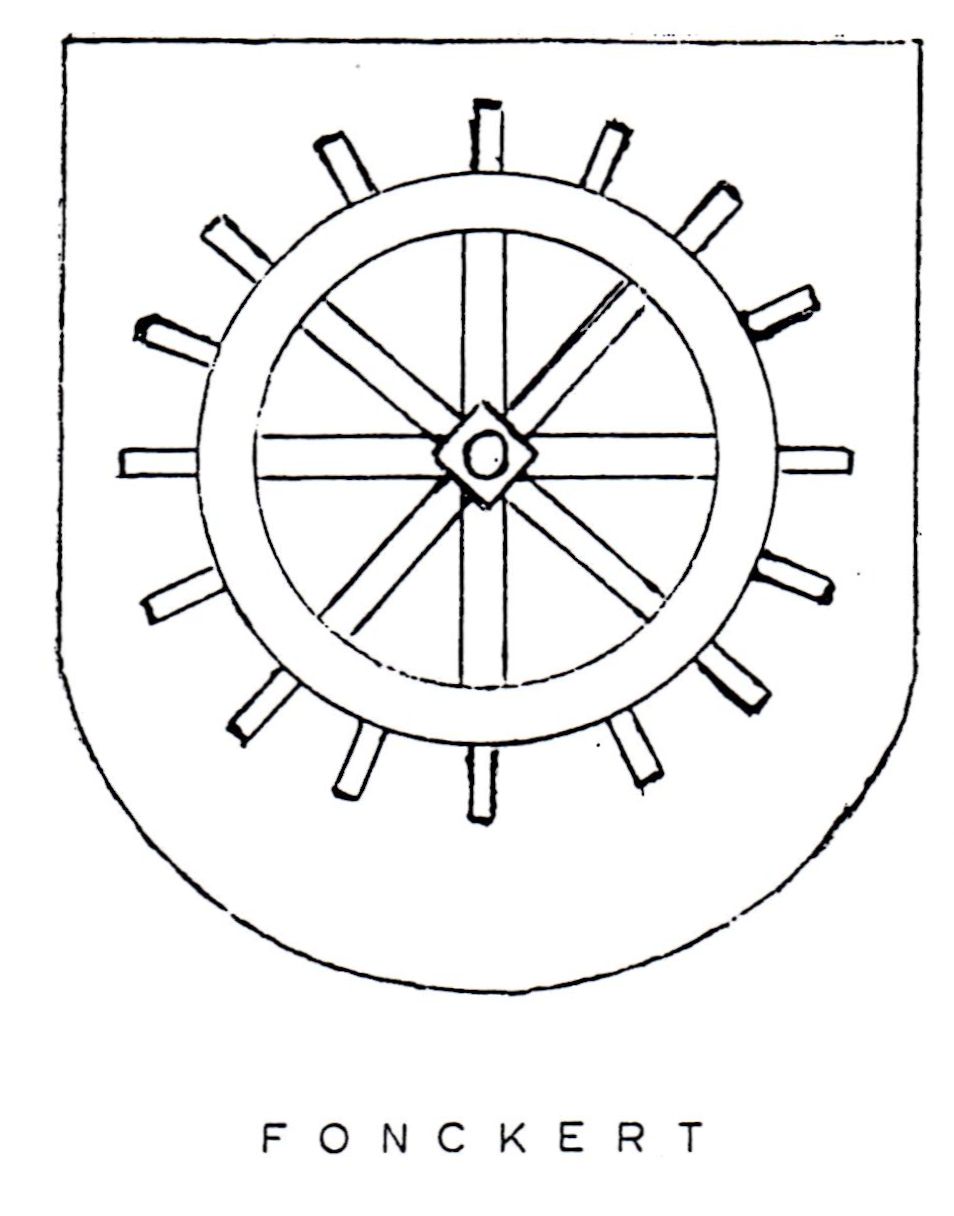
* At left, is an illustration of the Fonckert wapen, or arms from Dr. N. Vels Heijn and F. M. Vels Heijn-van der Kolk, Kwartierstaat Fonkert-Steehouwer, 1982. A condensed English version was given me by Phyllis Good (deceased) of Butler, New Jersey.